Why Does My Lower Back Hurt in the Morning? A Physiotherapist Explains

In This Article

Morning lower back pain is one of the most common complaints seen at Costa Health. Many patients describe their back feeling stiff, sore or locked first thing, only to find it improves as the day goes on. Some worry this means something is seriously wrong; others simply accept it as “ageing” or something they must put up with.
The truth is: morning back pain is extremely common, highly treatable, and usually has a very clear explanation.
Flora, our physiotherapist specialising in low back pain, sciatica and complex spinal cases, helps patients understand the patterns behind their symptoms and what can be done to improve them. In this Ask the Expert article, she explains the real reasons behind morning lower back pain, how discs and joints behave overnight, which symptoms to watch for, and the practical steps used at Costa Health to resolve this problem.
Need help with back pain, neck pain or sciatic pain?
If symptoms are new, severe or changing, a clinical assessment is the safest starting point. Our Back Pain, Neck Pain and Sciatica Clinic explains how Costa Health screens back pain, neck pain and sciatica, including when urgent medical care, imaging or specialist review may be needed.
Why Does Back Pain Feel Worse in the Morning?
Back pain often feels stronger in the morning because of a combination of mechanical, muscular and neurological factors that change overnight. These include disc hydration, stiffness in the surrounding muscles, reduced circulation, and sensitivity in irritated tissues.
1. Disc Hydration
Your spinal discs act as cushions between the vertebrae. Overnight, they re-absorb fluid and become slightly fuller. This is normal, but for people with disc irritation, bulging or early wear, this extra hydration creates more pressure and sensitivity when you first get up. Our article on whether disc bulges always need surgery explains this process in more detail.
2. Muscle Stiffness
During sleep, muscles switch off and are not actively supporting your spine. If your muscles are weak, tight or guarding from a previous injury, they can stiffen overnight and feel sore first thing.
3. Inflammation
Low-grade inflammation from irritated joints or discs can build up at night. When you begin to move again, the inflammatory chemicals disperse and the pain eases.
4. Poor Sleeping Position
Sleeping twisted, unsupported or on an inadequate mattress often increases morning discomfort.
5. Lack of Early Movement
Most people stretch, walk and bend throughout the day. Overnight, the spine remains still for hours. Movement lubricates the joints, so long periods of stillness naturally create stiffness.
Types of Morning Back Pain
You may recognise one of the following patterns:
- Sharp pain when first bending forward
- Stiffness when standing upright
- A “locked” or stuck feeling
- Pain that improves after a shower or a short walk
- Tightness spreading into the glutes or hips
- Mild nerve-type symptoms that ease after moving around
Each of these patterns tells us something important about the structures involved and helps guide a targeted treatment plan.
Is Morning Pain a Sign of a Disc Problem?
Not always - but it can be. Disc irritation is commonly worse first thing because discs are most hydrated in the morning. You may have a disc-related cause if you experience:
- Pain when bending forward
- Difficulty putting on socks
- Pain when sitting after waking
- Pain that radiates into the buttock or leg
- Pain that feels “central” in the spine
If several of these apply to you, a proper assessment is worthwhile. Our physiotherapy team or Chiropractic team can identify whether the disc is involved and design a plan accordingly.
Could It Be Sciatica?
Morning pain is common in people with sciatica because the nerve root is more sensitive when the disc is slightly fuller. True sciatica generally causes:
- Leg pain that is worse than the back pain
- Tingling, numbness or burning
- Pain with coughing or sneezing
- Pain when sitting
- Pain bending forward
If your symptoms improve after moving around, this is a positive sign. It suggests the nerve responds well to movement and is not trapped.
Quick Tip: If you wake with leg pain, tingling or numbness, try a gentle knees-to-chest stretch before getting out of bed. This can reduce disc pressure on the nerve and often makes that first step considerably more comfortable.
Why Movement Helps
Your spine is designed for movement, this is one of the most important things to understand about morning back pain.
Movement helps by:
- Reducing disc pressure
- Improving circulation
- Warming and softening the muscles
- Dispersing inflammation
- Reducing stiffness
- Calming an overactive nervous system
This is why morning pain so often improves after a shower, a short walk, or gentle stretches. It is not the pain “going away on its own” it is your body responding exactly as it should to movement.
How We Assess Morning Back Pain at Costa Health
Flora’s assessment for complex lower back pain includes:
- Disc loading tests
- Joint mobility assessment
- Nerve tension tests
- Hip and pelvis evaluation
- Core stability testing
- Sleep posture assessment
- Functional movement tests (bending, lifting, sitting)
Costa Health’s integrated team, where physiotherapists and chiropractors work alongside each other, means that both structural and functional causes can be evaluated in a single appointment. Find out more about Flora and our physiotherapy team in Mijas and Marbella.
How We Treat Morning Lower Back Pain
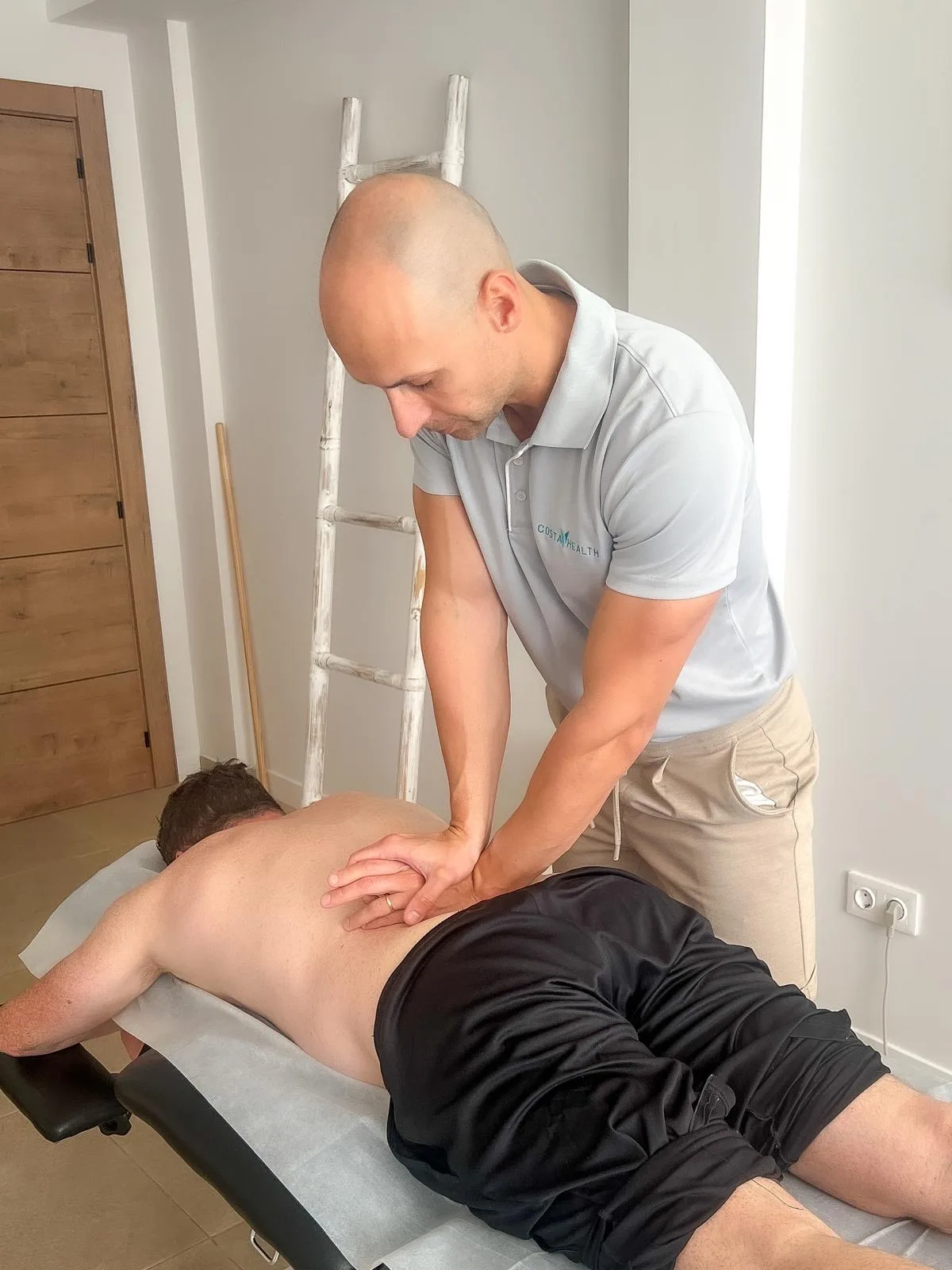
Manual Therapy and Spinal Mobilisation
Gentle mobilisations and manipulation techniques reduce joint stiffness and improve morning movement.
Disc-Friendly Movement Techniques
We teach repeated movement techniques that reduce disc sensitivity and ease nerve irritation.
Glute and Core Strengthening
Weak glutes and deep stabilisers commonly contribute to morning stiffness. Building strength here improves long-term resilience.
Hip Mobility Work
Tight hips force the lower back to compensate during bending and twisting. Improving hip range of motion relieves this additional load.
Posture and Sleep Position Coaching
Small changes to pillow height, mattress firmness and sleep posture can significantly reduce symptoms. This is often overlooked but makes a meaningful difference.
Sciatica-Specific Treatment
For nerve pain, we use nerve-gliding techniques, anti-inflammatory movement patterns, load management and a progressive strengthening programme.
Shockwave Therapy for Associated Problems
Where gluteal tendinopathy, sacroiliac joint overload or chronic muscle tightness is contributing, shockwave therapy can support recovery.
Quick Tip: Before getting out of bed, spend 60 seconds doing gentle pelvic tilts while lying on your back. Rock your pelvis slowly forward and back to begin lubricating the joints and warming the muscles. Many patients find this simple habit significantly reduces that initial “seized up” feeling.
A Morning Stretch Routine Flora Often Recommends
The following exercises can be done in bed or on a mat before you start your day. They are designed to reduce stiffness without aggravating disc or nerve symptoms:
- Gentle pelvic tilts
- Knees-to-chest stretch
- Cobra or McKenzie extensions (where appropriate)
- Hip flexor stretch
- Glute activation exercises
If you are unsure which exercises are suitable for your specific symptoms, a physiotherapy assessment will clarify this and provide a personalised routine.
When Morning Pain Is a Warning Sign
Most morning back pain is mechanical and responds well to treatment. However, seek prompt help if you experience any of the following:
- Pain that is getting progressively worse
- Numbness or weakness in the legs
- Difficulty standing upright
- Loss of bowel or bladder control (seek emergency medical attention immediately)
- Severe night pain that wakes you from sleep
- Pain that persists beyond 7-10 days without improvement
You Don’t Have to Live With Morning Back Pain
Morning back pain is frustrating, but it is not something you simply have to accept. Nearly all cases improve with the right guidance. By identifying which structures are involved and understanding your personal movement patterns, we can create a targeted plan that reduces stiffness, restores strength and helps you feel confident in your back again.
At Costa Health, our integrated approach combines manual therapy, spinal mobility work and rehabilitation ensuring long-term improvement, not just temporary relief. Book a physiotherapy assessment to find out what is driving your symptoms and how we can help.
Related Costa Health guides
- Back Pain, Neck Pain and Sciatica Clinic
- Back Pain
- The Best Exercises for Back Pain
- Do I Need a Scan, MRI or X-Ray?
Frequently Asked Questions
How long does morning lower back pain usually last?
Most people with mechanical morning back pain notice improvement within 30-60 minutes of getting up and moving around. If your pain takes significantly longer to ease, or is not improving at all, it is worth having a professional assessment to identify the underlying cause.
Could my mattress be causing my morning back pain?
It can be a contributing factor. A mattress that is too soft may allow the spine to sag overnight, while one that is too firm can create pressure points. That said, mattress changes alone rarely resolve back pain if there are underlying disc, joint or muscle issues. A physiotherapy assessment helps determine whether sleep posture is part of the problem.
Should I rest or keep moving when I have morning back pain?
Gentle movement is nearly always better than rest for mechanical back pain. The spine benefits from circulation and movement to reduce stiffness and disperse inflammation. Prolonged bed rest tends to make back pain worse, not better. Short, gentle walks and simple stretches are a good starting point.
Is morning back pain a sign of arthritis?
Spinal arthritis (spondylosis) can cause morning stiffness that improves with movement, and is one possible cause of morning back pain, particularly in older adults. However, it is not the only cause, and many people with arthritic changes visible on scans experience little or no pain. A thorough clinical assessment considers the full picture rather than relying on imaging alone.
When should I see a physiotherapist about morning back pain?
If your morning back pain has persisted for more than two weeks, is getting worse, or is accompanied by leg pain, numbness or tingling, it is worth booking an assessment. Early intervention tends to produce faster and more complete recovery than waiting to see whether it resolves on its own.