
What is causing your elbow pain?
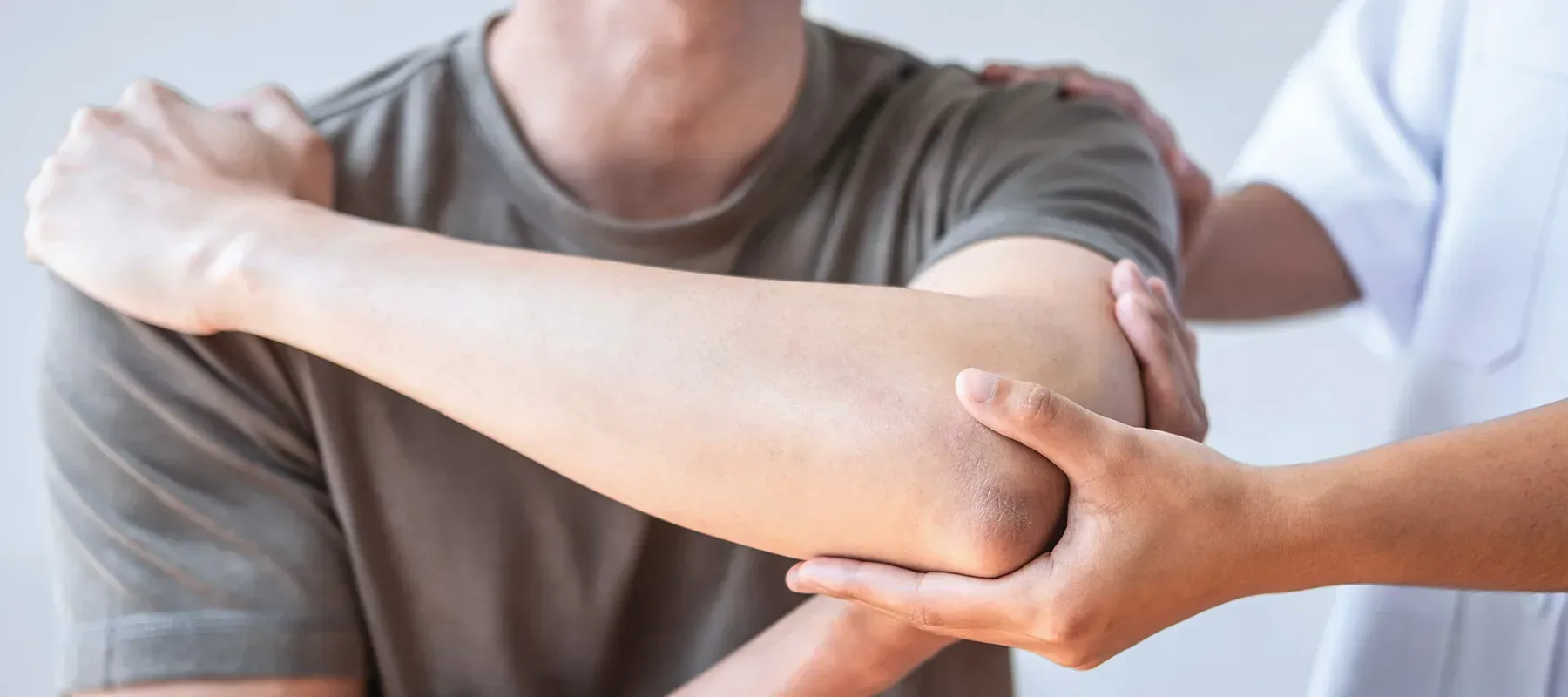
Elbow pain is usually a tendon problem, and tendons respond to specific loading, not rest alone. The two most common presentations are lateral epicondylalgia (tennis elbow) and medial epicondylalgia (golfer’s elbow), each involving different tendon groups on opposite sides of the elbow. At Costa Health, clinical assessment determines which tendons are affected, what’s driving the overload, and how to structure a recovery programme that addresses the root cause.
The elbow is a stable hinge joint that rarely dislocates or degenerates on its own. When it hurts, something elsewhere in the chain is usually contributing. A stiff thoracic spine, a weak shoulder, or a poorly controlled wrist can all shift excessive load onto the elbow tendons. This is why treating the elbow in isolation so often fails.
What is the difference between tennis elbow and golfer’s elbow?
Tennis elbow affects the lateral (outer) side of the elbow, specifically the common extensor tendon where the forearm muscles that extend the wrist and fingers attach. Pain is felt during gripping, lifting a kettle, or turning a door handle. Golfer’s elbow affects the medial (inner) side, involving the common flexor tendon. Pain occurs with gripping and wrist flexion, particularly when carrying heavy objects or shaking hands.
Research from the British Journal of General Practice (2014) estimates that lateral epicondylalgia affects 1-3% of the adult population annually, with peak incidence between ages 35-55. Medial epicondylalgia is less common, roughly four to seven times less prevalent, but tends to be more persistent once established.
A firm clinical position supported by current evidence: the old model of “tendinitis” (acute inflammation) has been largely replaced by “tendinopathy” (failed healing response with disorganised collagen). This distinction matters because anti-inflammatory treatments, including ice and ibuprofen, may reduce pain temporarily but don’t address the underlying tendon structure. Progressive tendon loading, specifically isometric and then eccentric exercises, remains the gold-standard first-line treatment.
Why has padel created an epidemic of elbow pain on the Costa del Sol?
Padel has exploded across Spain, and the Costa del Sol is at the epicentre. The sport’s unique mechanics place extraordinary demands on the elbow. Unlike tennis, padel is played almost entirely within arm’s reach of the body, with a shorter, heavier racquet and a wrist-dominant technique. The repetitive wrist action during bandeja, vibora, and wall shots loads the extensor tendons relentlessly.
Three factors make padel particularly harsh on elbows. The solid, stringless racquet transmits more vibration directly into the forearm than a strung tennis racquet. Court surfaces are often artificial turf with sand, producing an unpredictable bounce that forces reactive, tension-heavy grip responses. Players frequently grip the racquet too tightly, a compensation for technique gaps that dramatically increases tendon load.
Daniele Delicati (MSc, BSc (Hons), MACP, MCSP, HCPC), Costa Health’s physiotherapist, estimates that elbow presentations at the clinic increase by approximately 40% during the autumn and winter sporting season. Many of these patients are recreational padel players who’ve rapidly increased their playing frequency without conditioning their forearm tendons for the demands.
What about elbow pain in golfers?
Golf-related elbow pain doesn’t always present as “golfer’s elbow.” The trail arm (right arm for a right-handed player) is susceptible to lateral epicondylalgia because the extensor muscles work eccentrically through impact to control wrist position. The lead arm is more prone to medial epicondylalgia from the flexion forces at impact.
A patient presenting with persistent elbow pain from golf who hasn’t responded to standard treatment often has a contributing factor higher up the chain. Limited thoracic rotation forces the arms to generate power that should come from the trunk. Restricted shoulder external rotation alters the elbow’s position at impact. These biomechanical compensations are common in golfers over 50, whose spinal mobility has decreased without proportional technique adjustment.
Costa Health’s golf performance analysis identifies these movement limitations specifically. Addressing thoracic and shoulder mobility alongside targeted forearm rehabilitation produces significantly better outcomes than treating the elbow alone.
How is elbow pain treated at Costa Health?
Elbow tendinopathy responds best to a structured, progressive approach. The evidence for isometric loading (sustained contraction without movement) as an initial pain-management tool is strong, followed by slow heavy eccentric loading as symptoms allow. This approach stimulates collagen remodelling within the tendon, addressing the underlying pathology rather than just the symptoms.
Physiotherapy at Costa Health builds individualised loading programmes that progress from isometric holds through to functional strengthening and sport-specific drills. For padel and tennis players, this includes grip-strength conditioning, wrist extensor endurance work, and graduated return-to-play protocols. Sports massage targets the forearm musculature, releasing hypertonic wrist extensors and flexors that contribute to tendon overload.
Chiropractic assessment of the cervical spine is relevant in many elbow cases. The C5-C6 nerve roots supply the muscles around the elbow, and cervical joint restrictions or disc irritation can sensitise these neural pathways, amplifying pain at the elbow. Addressing the cervical component can make the difference between a tendinopathy that resolves and one that plateaus. Osteopathy examines the upper limb as a connected system, from thoracic outlet to radiohumeral joint, identifying restrictions that alter how force is distributed through the arm.
When should elbow pain be assessed urgently?
Most elbow pain is mechanical and non-urgent, but certain presentations warrant prompt attention. Elbow pain following a fall onto an outstretched hand, especially with swelling and inability to fully straighten or bend the joint, may indicate a fracture. In children, a pulled elbow (radial head subluxation) is common and presents as sudden refusal to use the arm after a yanking force.
An edge case to be aware of: medial elbow pain in adolescent throwing athletes (cricket bowlers, baseball pitchers) can indicate stress to the medial epicondyle growth plate. This is a different pathology from adult golfer’s elbow and requires specialist assessment, as continued loading risks an avulsion fracture.
For the typical recreational athlete or desk worker with gradually worsening elbow pain, a clinical assessment at Costa Health will determine whether the problem is a straightforward tendinopathy, a referred issue from the neck or shoulder, or something that requires imaging. The right diagnosis at the start saves months of ineffective self-treatment.