
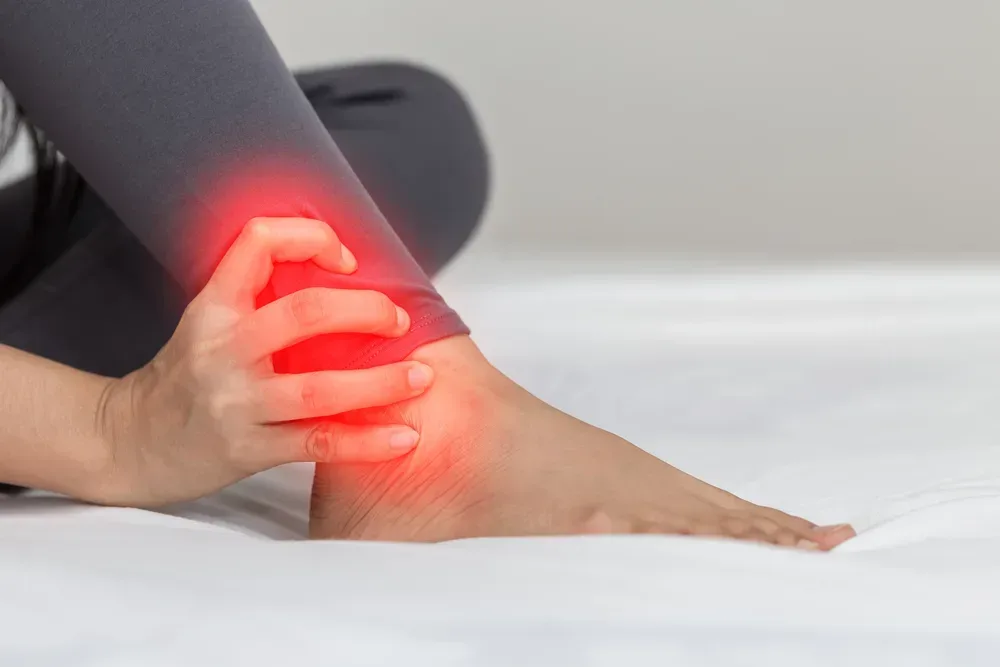

What’s causing your ankle pain?
Ankle pain most commonly results from ligament sprains, tendon injuries, or joint restriction. A lateral ankle sprain, where the foot rolls inward and damages the outer ligaments, accounts for roughly 85% of all ankle injuries. Most heal well with proper rehabilitation, but up to 40% of patients develop chronic ankle instability when the initial injury isn’t treated correctly.
That statistic matters. A rolled ankle is one of the most undertreated injuries in musculoskeletal medicine. Patients assume if the swelling goes down and they can walk, they’re fine. They’re often not. The ligaments may have healed in a lengthened position, the proprioceptive feedback from the joint is impaired, and the peroneal muscles that protect against further sprains are weak. This is how one bad sprain in your twenties becomes a pattern of repeated injuries and an arthritic ankle by fifty.
Beyond sprains, ankle pain can stem from Achilles tendinopathy, posterior tibial tendon dysfunction (the most common cause of adult-acquired flat foot), ankle impingement, stress fractures, and osteoarthritis. Each requires different treatment. Getting the diagnosis right is the essential first step.
How are ankle sprains graded, and why does it matter?
Ankle sprains are classified into three grades based on severity. Grade I involves stretching of the anterior talofibular ligament (ATFL) with microscopic tearing. Swelling is mild, the joint feels stable, and weight-bearing is uncomfortable but possible. Recovery typically takes two to four weeks with appropriate treatment.
Grade II means partial tearing of the ATFL, often with involvement of the calcaneofibular ligament (CFL). Moderate swelling, bruising, and difficulty weight-bearing characterise this grade. A research review in the British Journal of Sports Medicine found that Grade II sprains require six to eight weeks of structured rehabilitation for optimal outcomes.
Grade III is a complete rupture of one or more ligaments. The ankle feels unstable, swelling is significant, and weight-bearing is often impossible initially. Despite the severity, surgery is rarely needed. A 2017 Cochrane review concluded that functional rehabilitation produces outcomes equal to surgical repair for most Grade III lateral ankle sprains, with fewer complications and faster return to activity.
The grading determines the treatment timeline, the type of bracing required, and when progressive loading can safely begin. Sarah Monaghan, chiropractor at Costa Health with over 20 years of clinical experience and GCC registration, uses stress testing and functional assessment to classify each sprain accurately.
What does proper ankle rehabilitation look like?
Rehabilitation follows a structured progression. The first phase focuses on protecting the injury, managing swelling through compression and elevation, and maintaining range of motion within pain-free limits. Early gentle movement is better than complete immobilisation. A landmark study by Bleakley et al. (2010) demonstrated that early functional treatment produced faster recovery than standard RICE protocol alone.
Phase two introduces progressive weight-bearing, range of motion exercises, and initial strengthening. Calf raises, toe curls, and resistance band exercises for the peroneal muscles form the foundation. Physiotherapy is particularly effective during this phase, with targeted exercise prescription matching each patient’s specific deficits.
Phase three is where most rehabilitation programmes fall short. Balance and proprioception training, single-leg stance progressions, wobble board work, and sport-specific agility drills are what prevent recurrence. Without this phase, the ankle remains vulnerable. Chiropractic mobilisation of restricted talocrural and subtalar joints ensures full range of motion returns. Osteopathy addresses compensatory patterns that develop during the injury period, particularly in the knee, hip, and lower back. Sports massage targets the often-forgotten peroneal muscles and calf tissue that tighten protectively around the injury.
When can you return to sport after an ankle sprain?
This is the question every active patient asks first. The honest answer depends on the grade of injury, the quality of rehabilitation, and the demands of the sport.
Grade I sprains typically allow return to sport at two to three weeks, provided single-leg balance is restored, full range of motion is achieved, and the patient can hop and land without pain or apprehension. Grade II injuries need six to eight weeks minimum. Grade III sprains require three to four months of structured rehabilitation before high-demand sport is safe.
Common misconception: “I can run on it, so I’m ready to play.” Running in a straight line at moderate pace is not the same as cutting, pivoting, or landing from a jump. The lateral forces involved in sports like padel, tennis, and football are precisely the movements that re-injure an incompletely rehabilitated ankle. Costa Health clinicians use functional testing, including the Star Excursion Balance Test and hop tests, to determine genuine readiness rather than relying on pain alone.
Living on the Costa del Sol adds specific considerations. Uneven terrain on hiking trails, sandy beach surfaces, and the transition between pool deck tiles and grass all challenge ankle stability in ways that flat gym floors don’t. Rehabilitation should include these real-world surfaces once the patient is ready.
What about chronic ankle instability?
Chronic ankle instability affects patients who’ve sprained their ankle multiple times and now find it gives way during everyday activities. The joint feels loose. Confidence is low. The problem is rarely the ligaments alone. Neuromuscular control, the brain’s ability to sense joint position and activate stabilising muscles quickly enough, is the real deficit.
A structured programme of progressive balance training can restore this control even years after the original injury. Research published in the Journal of Athletic Training found that six weeks of balance training reduced the rate of recurrent sprains by 50% in athletes with chronic instability.
Ankle bracing and taping have their place during sport, but they’re a supplement to rehabilitation, not a substitute. Relying on external support without rebuilding internal stability is a short-term strategy that doesn’t address the underlying problem.
What does an ankle assessment at Costa Health involve?
Assessment starts with a detailed injury history, including mechanism, previous sprains, current symptoms, and functional limitations. Clinical testing includes range of motion measurement, ligament stress tests, muscle strength assessment, and proprioceptive evaluation. Flora Muijzer, physiotherapist at Costa Health, works alongside Sarah Monaghan to ensure both the joint mechanics and the neuromuscular rehabilitation are addressed.
Imaging is requested when clinical findings suggest fracture, significant ligament rupture, or osteochondral injury. The Ottawa Ankle Rules provide a validated screening tool to determine when X-rays are genuinely needed, avoiding unnecessary radiation for simple sprains.
For patients whose ankle pain overlaps with Achilles tendinopathy or shin splints, the multidisciplinary approach ensures the entire lower limb chain is assessed and treated, not just the ankle in isolation. Treatment plans are built around each patient’s activity goals, whether that’s walking the dog pain-free, returning to padel, or completing a trail run in the hills above Marbella.