
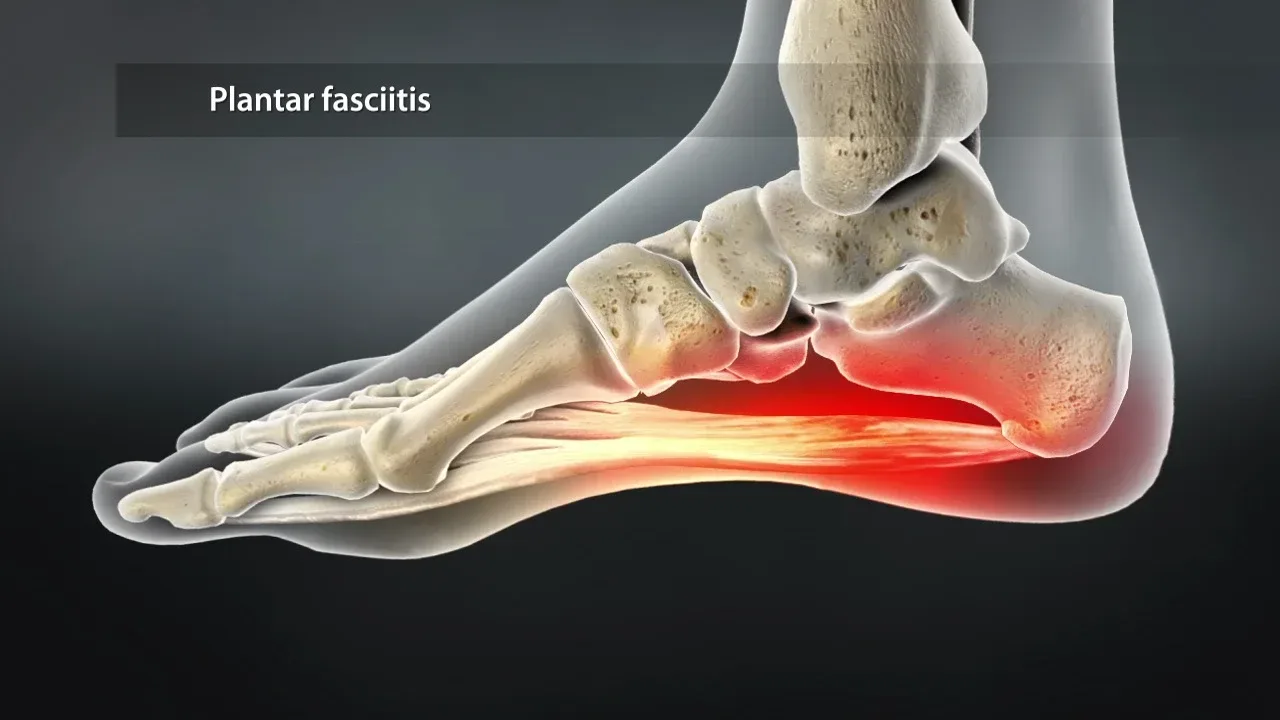

Plantar fasciitis is inflammation of the thick band of connective tissue running from the heel bone to the base of the toes. It typically produces a sharp, stabbing pain under the heel that’s worst during the first few steps after waking or after prolonged sitting, and it is the most common cause of heel pain.
Most people picture plantar fasciitis as a runner’s injury. It isn’t exclusively that. Office workers who stand on hard floors all day, new parents carrying extra weight on minimal sleep, and retirees walking Marbella’s marble pavements in thin-soled sandals all turn up at Costa Health with the same complaint. The condition doesn’t discriminate.
What actually happens inside the foot?
The plantar fascia is not a muscle. It’s a dense, fibrous band of connective tissue that acts like a bowstring supporting the arch. Repeated microtrauma causes small tears where the fascia attaches to the calcaneus (heel bone). The body’s repair response produces thickened, disorganised tissue rather than healthy fascia. Researchers at the University of Melbourne found that histological examination of chronic plantar fasciitis tissue shows degenerative changes rather than acute inflammation, which is why the condition is sometimes more accurately called plantar fasciosis (Lemont et al., Foot and Ankle Surgery, 2003).
That distinction matters clinically. Anti-inflammatory strategies alone won’t fix tissue that has moved beyond inflammation into degeneration. Treatment needs to address both the pain and the structural quality of the fascia.
Who gets plantar fasciitis, and why?
A 2019 systematic review published in the Journal of Foot and Ankle Research estimated the prevalence of plantar fasciitis at approximately 10% of adults over 50, rising further in runners and people with sedentary occupations involving prolonged standing. Several factors converge to trigger it.
Tight calf muscles and a stiff Achilles tendon transfer excessive load into the plantar fascia with every step. High arches concentrate that load on a smaller area, while flat feet allow the fascia to overstretch. Sudden changes in training volume, a switch from supportive trainers to flat shoes, and rapid weight gain all increase risk. Sarah Monaghan, Costa Health’s principal chiropractor with over 20 years of clinical experience, frequently sees cases triggered by something as simple as a holiday hiking trip in unsuitable footwear.
One common misconception is that heel spurs cause plantar fasciitis pain. Imaging studies show that many people with heel spurs have no symptoms at all, and many people with agonising plantar fasciitis have no spur. The spur is a consequence of chronic traction, not the source of pain.
How does a clinician diagnose it?
Diagnosis is clinical in most cases. Pressing the medial calcaneal tubercle (the inside front of the heel bone) reproduces the characteristic pain. Windlass testing, where the clinician dorsiflexes the big toe to tension the fascia, confirms the diagnosis. Imaging is reserved for cases where stress fracture, nerve entrapment, or other differential diagnoses need ruling out.
An important edge case: if heel pain is bilateral and accompanied by morning stiffness lasting more than 30 minutes, clinicians should consider inflammatory arthropathies such as ankylosing spondylitis or reactive arthritis, particularly in younger patients. This warrants blood tests and referral.
What treatment options does Costa Health offer?
Plantar fasciitis responds well to a multidisciplinary approach. No single intervention works in isolation, which is why Costa Health’s team draws on chiropractic, physiotherapy, osteopathy, and sports massage depending on what each patient needs.
Chiropractic treatment addresses joint restrictions in the foot, ankle, and lower limb that alter biomechanics and overload the fascia. Mobilisation of the subtalar and midtarsal joints restores normal movement patterns and reduces compensatory strain.
Physiotherapy focuses on progressive loading through eccentric exercises and plantar fascia-specific stretching. The evidence supporting eccentric calf raises for Achilles and plantar fascia conditions is strong, with a 2014 Scandinavian study by Rathleff et al. showing high-load strength training produced superior outcomes to stretching alone at three months.
Osteopathic treatment takes a whole-body view, examining how hip, knee, and spinal mechanics contribute to abnormal foot loading. Soft tissue work through the posterior chain, from the lumbar spine down through the hamstrings and calves, often produces immediate relief.
Sports massage targets the gastrocnemius, soleus, and intrinsic foot muscles to release tension that perpetuates the problem. Deep tissue techniques applied to the calf complex reduce the mechanical pull on the Achilles tendon and, by extension, the plantar fascia.
When should you seek urgent care?
Most plantar fasciitis is uncomfortable but not dangerous. Seek prompt medical attention if you experience sudden onset heel pain after a fall or impact (possible calcaneal fracture), numbness or tingling in the foot (possible nerve entrapment such as tarsal tunnel syndrome), or heel pain accompanied by fever and warmth (possible infection). These presentations require imaging and potentially specialist referral beyond what conservative manual therapy addresses.
How long does recovery take?
Honest answer: it depends. Mild cases caught early often resolve within six to eight weeks of consistent treatment and home exercises. Chronic cases where symptoms have been present for more than six months typically take three to six months of structured rehabilitation. The single biggest predictor of recovery speed is compliance with home exercises, particularly calf stretching and intrinsic foot strengthening.
Patience matters. The plantar fascia bears your entire body weight with every step, so it never gets true rest. That slow mechanical loading is precisely why progressive exercise, rather than complete rest, produces better long-term outcomes.
Booking an assessment at Costa Health is the fastest way to get a clear diagnosis and a treatment plan tailored to your specific biomechanics. The clinic’s practitioners work together so you’re never limited to one approach when your foot needs several.